
The IKEA Effect in Advertising: Why Effort Creates Wanting
That people prize what they helped build is well established. What nobody writes down is the far more useful half: the conditions under which it stops working, which is most of them.
In short
- Effort only creates value when it succeeds. Effort that fails produces the opposite effect, and fairly strongly.
- The curve is an arch, not a slope. A little work raises what people feel about a thing; more work keeps raising it briefly, then turns and falls away sharply.
- Chosen effort and imposed effort are not the same input. Work you opted into builds attachment; work demanded of you builds resentment, even when the task is identical.
- An ad has an unusually narrow band to sit in, because the player never agreed to do anything and can leave at no cost.
- The practical test is whether the player could plausibly describe what they achieved. If they cannot name it, no effect was produced, whatever the session length says.
Give someone a task, let them finish it, and they will think more of the result than anyone who was simply handed the same thing. That finding is robust, it has been replicated across furniture and origami and Lego, and we have written about the mechanism behind it elsewhere.
This piece is about the other half, which is much less often discussed and much more useful if you are actually building something: the effect has edges. Cross one and it does not merely stop. It reverses.
That matters enormously for advertising, because an ad is asking for effort from a person who did not volunteer for it, has no investment in the outcome and can leave instantly at no cost. If there is a fragile version of these conditions anywhere, this is it.
The curve is an arch
The tempting reading of the research is that effort is an ingredient: add more, get more attachment. That is not what the studies show, and building on that assumption produces ads that fail in a specific, recognisable way.
What the evidence actually describes is an arch. Attachment climbs steeply from zero — the difference between doing nothing and doing one small thing is the largest single jump on the whole curve. It keeps climbing for a while. Then it peaks, turns, and falls away faster than it rose.
The falling side is not a weaker version of the effect. It is a different feeling entirely. On the left of the peak, people describe the object as theirs. On the right, they describe the task as a hassle — and the object inherits that.
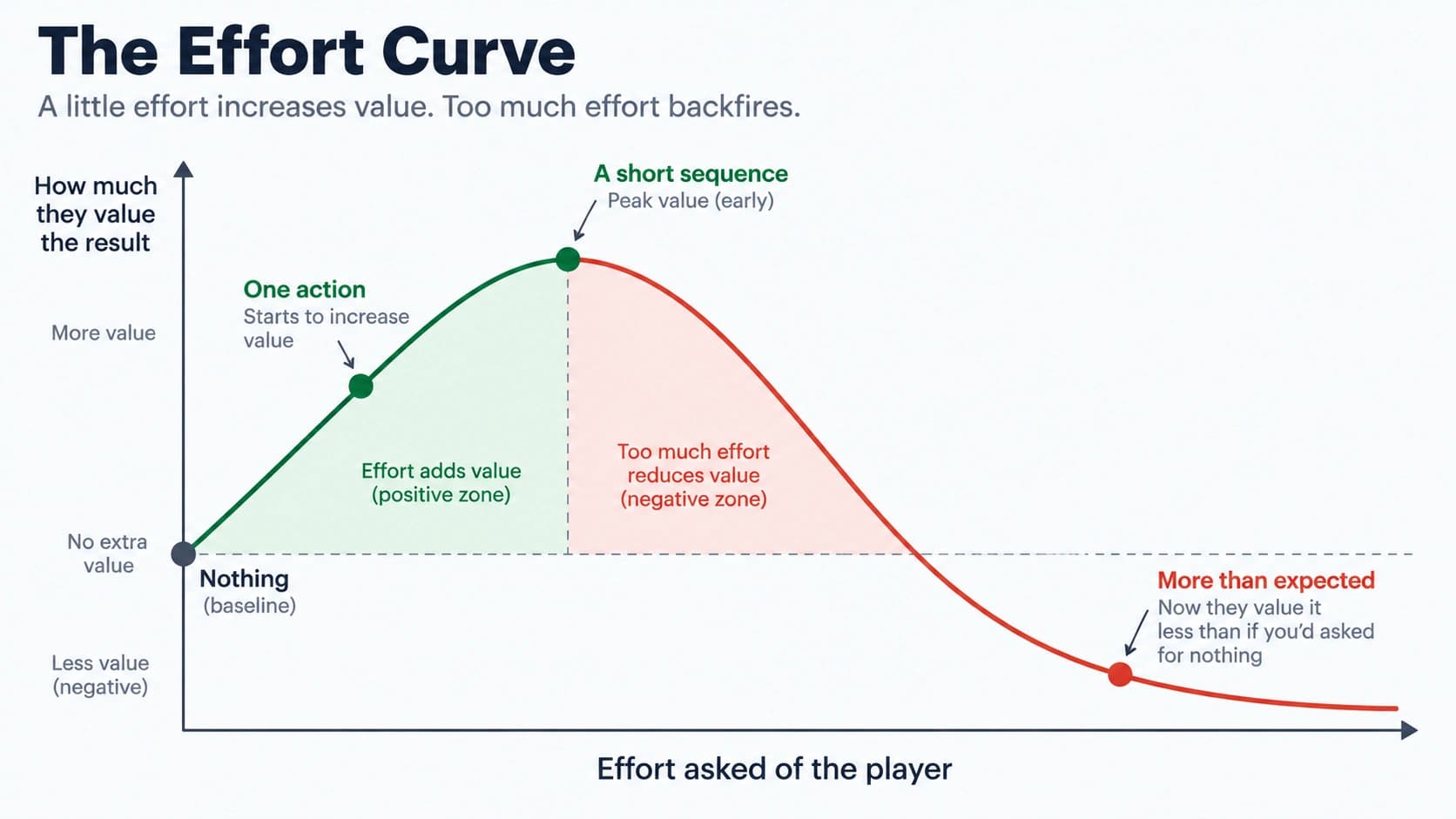
The same interaction at four levels of demand, and what the person is left holding:
| What was asked | What the person feels afterwards |
|---|---|
| Nothing at all | Neutral. They watched a thing happen. No ownership, because there was nothing to own. |
| One meaningful action | The biggest jump on the curve. Small but real sense of having done something, and it attaches to whatever they did it to. |
| A short sequence they complete | The peak for most ad contexts. Enough to feel like an achievement, short enough that it never felt like work. |
| More than they expected to give | The reversal. The feeling is not pride in the result but relief that it is over, and relief attaches to the exit, not the product. |
Where exactly the peak sits depends on context, and this is the part that makes borrowing numbers from the research so dangerous. The original studies had participants who had agreed to be in an experiment, were in a room, and had an implicit obligation to finish. Twenty minutes of assembly was inside their band.
A stranger in a feed has none of those things. Their band is measured in seconds, and the peak arrives far earlier than anyone's instinct suggests.
The difference between no effort and a little effort is the biggest gap on the curve. Almost everything after that is a smaller gain at a rising risk.
Chosen effort and imposed effort
There is a second variable that matters at least as much as quantity, and it gets almost no attention: whether the person chose the work.
Identical tasks produce opposite feelings depending on how they arrived. Cooking a meal because you wanted to is satisfying. Cooking the same meal because someone told you to, on a night you had other plans, is a chore. The chopping is the same chopping.
Advertising starts on the wrong side of this by default. Nobody opens an app hoping for an ad, so every demand an ad makes is imposed rather than chosen. The format's whole challenge is converting an imposed interaction into one that feels elected, quickly, before the person decides they are being made to do something.
That is what separates a playable that feels like a small gift from one that feels like a toll booth. Not the amount of work — the sense of having picked it up rather than been handed it.
What makes an imposed interaction start to feel chosen:
- It can be ignored without punishment. Something that waits for you, rather than blocking you, reads as an offer. A gate reads as a demand.
- The first move is obvious and optional. If the player can see what to do and does it because it looks appealing, they have elected it. If they do it because nothing else is possible, they have complied.
- It ends earlier than they expect. Finishing before the person starts wondering how long this goes on is the single clearest signal that you were not trying to extract anything.
- There is no visible meter. Progress bars, level counters and step indicators announce that a quantity of work is being required, which makes the work feel imposed even when it is trivial.
- Nothing is withheld behind it. The moment completing the interaction becomes the price of seeing something, it stops being play and becomes a transaction.
Forced interaction is the clearest way to invert the effect
Some ads will not proceed until the player taps a specific target, and hold the screen hostage until they do. This reliably produces the tap and reliably destroys everything the tap was supposed to buy. The player has been made to perform a gesture rather than choosing to act — so there is no authorship, no ownership, and an entirely accurate impression that the advertiser was willing to waste their time to get a number.
The player has to be able to name what they did
Here is the most practical test we know for whether an interaction is doing any of this work.
Imagine stopping the player the instant the end card appears and asking what they just did. If they can answer in a short sentence — I matched the blue ones, I got the car through the gap, I built the little shop — the effect had something to attach to. If the honest answer is I tapped some things, nothing was produced no matter how long they were engaged.
This is why session length is such a poor proxy. A player can spend twenty seconds in an ad, tap fourteen times, and leave with no describable achievement whatsoever. Another can spend six seconds, make one decision, complete one thing, and leave with a small clear memory of having done it.
Ownership needs an object. A pile of inputs is not an object.
Did
A nameable outcome the player produced — the thing ownership attaches to
Tapped
Activity with no resolution, which produces nothing at all
Endured
Effort past the peak, which attaches a feeling you did not want
Designing inside the band
If the effect is an arch, and an ad sits in a narrow part of it, then the design problem is not how do I get more engagement. It is how do I get one clean completion before the peak.
Five ways to stay on the useful side of the curve.
- 1
Decide what the player will have made
Before anything else, write down the sentence they should be able to say afterwards. If you cannot write it, the interaction has no object and there is nothing for the effect to work on. This one decision does more than any amount of polish.
- 2
Make the first action the smallest possible real one
The steepest part of the climb is the step from nothing to something. Get them across it immediately with an action that genuinely affects the screen, and you have banked most of the available benefit in about a second.
- 3
Finish something before you ask for anything else
A completed small thing beats an incomplete larger one, every time. If the ad ends mid-task, the player is holding effort that never resolved — which the research suggests is worse than having asked nothing of them.
- 4
Cut the second challenge
The instinct after a successful first interaction is to offer another. That is usually the step over the peak. The player has the feeling you wanted; extending the session spends it down rather than building on it.
- 5
Never let difficulty do the work of engagement
Harder does not mean more invested — it means more people who quit before completing, and completion is where the entire effect lives. If you want the interaction to feel more substantial, make the outcome more visible, not the task more demanding.
Where this stops being reliable
The effect is routinely oversold in this industry, so it is worth marking how far it actually reaches.
The research was not conducted on advertising, and the gap is not small. Participants assembled boxes for twenty minutes having agreed to take part. A person tapping twice in a feed, having agreed to nothing, is in a different situation, and the claim that the same curve governs both is an extrapolation rather than a finding. The direction is well supported. The magnitude, at this scale, is not measured.
It is also worth saying that the effect is modest even where it is strongest. It nudges valuation; it does not manufacture desire for something a person had no use for. An ad that produces a clean sense of authorship for a product somebody does not want has produced a pleasant few seconds and no customer.
The reason to take it seriously is not that it is powerful. It is that it is cheap. Getting it right costs one design decision, and getting it wrong — pushing past the peak — actively damages what you were buying.
Effort is not a dial you turn up. It is a band you stay inside, and the band is narrower than anyone's instinct suggests.
Questions this one tends to raise.
How much effort is the right amount for an ad?
Less than feels sufficient. One meaningful action with a visible result captures most of the available effect, and a short sequence that reaches a clear finish is around the peak for a feed placement. The reliable failure is asking for a second challenge after the first succeeded, which spends the feeling rather than building it.
Does the effect work if the player loses?
Losing and not finishing are different things. A near miss the player understands and could have avoided still produces a sense of agency, and often a stronger urge to try again. An interaction that simply ends before anything resolved produces nothing, because the effect depends on completion rather than outcome.
Is this the same as sunk cost?
No, and the difference is practical rather than academic. Sunk cost makes people reluctant to walk away from something they have invested in. This makes people prefer the thing itself, including over alternatives they had no hand in. One is about not leaving; the other is about wanting.
Can you get the effect without a game mechanic?
Yes, and this is where non-gaming advertisers usually miss it. A configurator that produces a version of a product the person specified, a short set of choices ending in a result that is recognisably theirs — both create an object with the person's fingerprints on it. The requirement is authorship of a result, not entertainment.
Does a tutorial hand help or hurt here?
Mostly hurts, in this specific respect. If the hand shows the only possible move, the player performed a gesture rather than making a decision, and the outcome is not authored by them in any meaningful sense. A hand that appears after hesitation, as help rather than instruction, costs much less.
Editorial
The Play Ads Maker team
We build the editor behind this site, which means we spend our days inside the format — its constraints, its export limits, and the question of what actually makes someone tap. We write about what we learn doing it.
The fastest way to understand the format is to build one
The editor is free to open, runs in the browser, and needs no code. Start from a template and have something playable within the hour.
Keep reading
Why Your Brain Trusts What You Touched
People value what they had a hand in, remember what they did more reliably than what they saw, and believe their own conclusions over anyone else's. Interactive advertising runs on all three.
10 min readThe Zeigarnik Effect
Interrupted tasks stay active in the mind in a way completed ones do not. The useful part for advertising is not the ad itself — it is what survives the walk to the store.
9 min readThe Almost-Winning Question
It is one of the most repeated claims in this industry and one of the least examined. The effect is real in slot machines. Whether it transfers to an ad depends on something the slot research had no reason to measure.
10 min read